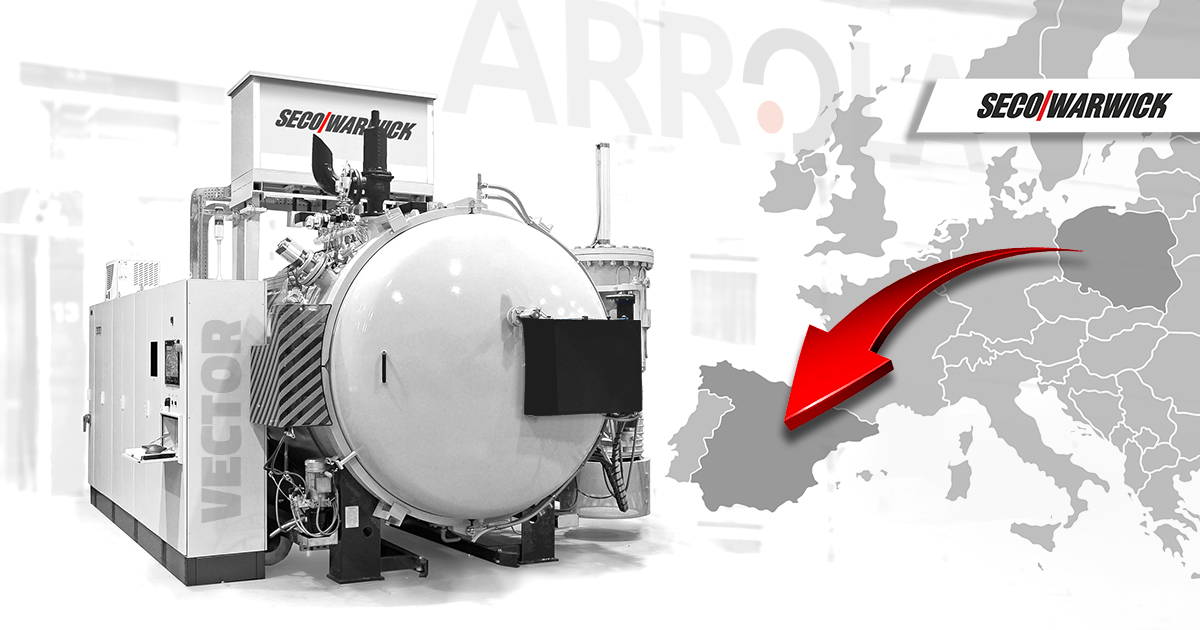




SECO/WARWICK will deliver a single chamber vacuum furnace with 15 bar abs high pressure gas quenching to the Czech heat treat company Kalírna Desire. Kalírna Desire is opening a new commercial heat treat facility in a region that has so far lacked local infrastructure for vacuum hardening. The Vector furnace will be the first vacuum system in operation, and the foundation for a new line of business built around vacuum heat treatment services—both for in-house production and for nearby manufacturers.
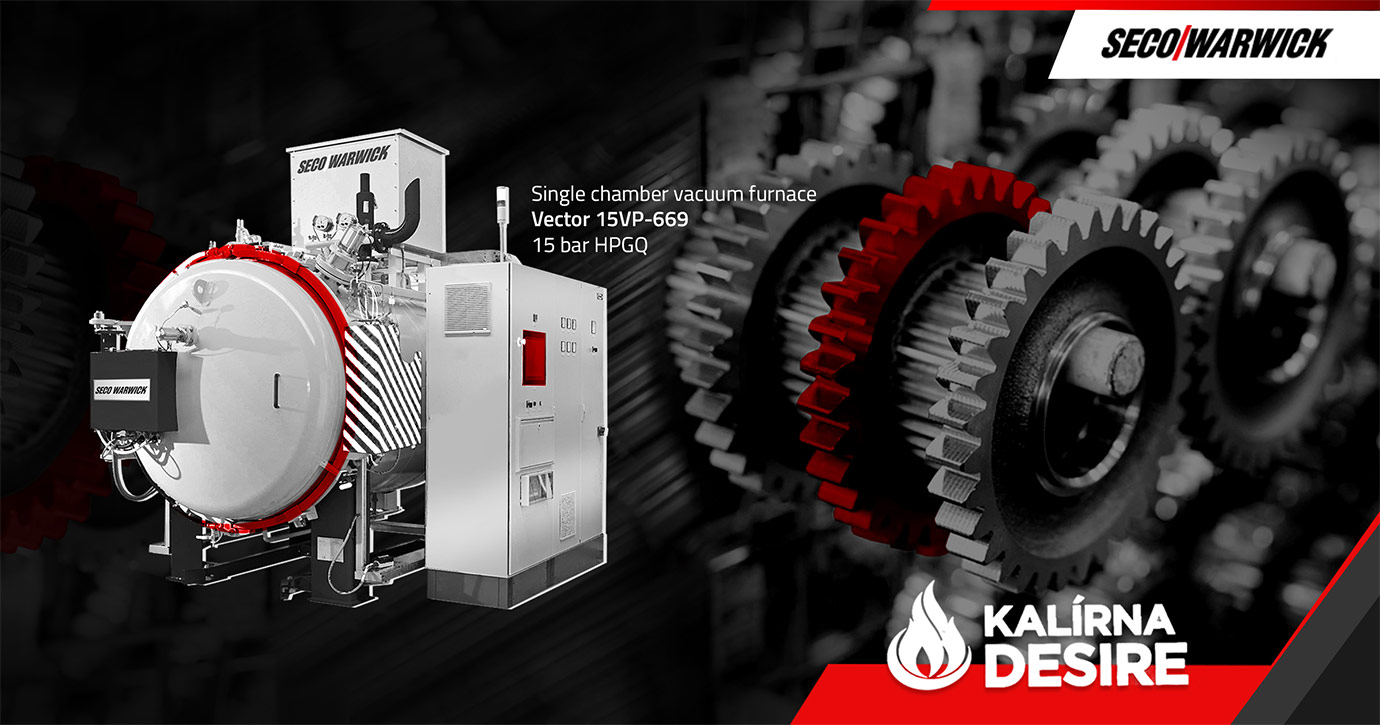
Kalírna Desire is launching an in-house vacuum heat treatment service using SECO/WARWICK technology to eliminate reliance on distant suppliers and serve local regional demand.
- Kalírna Desire invested in a SECO/WARWICK Vector vacuum furnace.
- The move reduces logistics costs and lead times by ending reliance on distant providers.
- The company aims to become a local provider for regional metal processing firms.
- The furnace offers advanced features like convection heating and LPC.
- In-house treatment improves production control, quality, and flexibility.
The Owners of Kalírna Desire have extenisive experience in mechanical engineering production on their own machines. Experience from operating this production has pointed to insufficient capacity and flexibility in the material processing industry in their region. For years, the company relied on a distant commercial heat treat provider resulting in long lead times, the risk of delays and additional logistics costs. At the same time, the owners observed that within a radius of roughly some kilometers there are many companies engaged in metal mechanical processing, but no local provider of vacuum hardening services. This analysis led to the decision to launch their own—initially small—commercial heat treat operation, which in the first stage will be the start of production for regional companies in the area.
“Our collaboration with Kalírna Desire is an excellent example of how vacuum technology can become a growth engine for ambitious small and mid-sized companies. SECO/WARWICK has worked with commercial heat treat shops across Europe for many years, and experience from the Czech market played an important role in the customer’s decision making. A standard Vector furnace, adapted to the Partner’s requirements, combines a sensible investment level with broad process capabilities—making it an ideal solution for companies beginning their journey with vacuum heat treatment,” says Maciej Korecki, Vice President, Vacuum Segment, SECO/WARWICK Group.
A small shop with big capabilities
The selected furnace is a mid-size solution configured specifically for the needs of a commercial heat-treatment facility. The work zone supports processing relatively large parts and building efficient loads typical of job shops working with a wide range of tool and structural steel grades. A round heating chamber provides very good temperature uniformity, translating into high repeatability of hardening and tempering results.
“The furnace is equipped with a convection heating system, which significantly improves heating efficiency at lower temperatures, enabling precise control of preheating processes. Directional cooling, in turn, enables optimized quenching for parts with complex geometries while minimizing distortion risk. An isothermal quenching function was also implemented; by controlling the load temperature and regulating blower operation via a frequency inverter, it gives the user full control over the cooling profile. We have extensive experience equipping commercial heat treat shops. We have worked for both large industrial companies and local small suppliers. Regardless of the scale, we always share our know-how—helping customers select the right equipment and advising which functions will translate into more orders and better profits for our Partners,” explains Łukasz Chwiałkowski, Sales Manager, SECO/WARWICK.
A pragmatic solution tailored to real needs
The vacuum system of the unit ordered is based on a mechanical pump and a Roots pump, ensuring stable medium-vacuum conditions and high process cleanliness. An important part of the configuration is also the partial-pressure system, which prevents evaporation and sublimation of alloying elements from the load surface and reduces contamination of the hot zone. The setup is complemented by a high-capacity cooling system. The furnace is also equipped with the low-pressure carburizing (LPC) option, enabling precise processes to increase the surface hardness of steel within a single, integrated vacuum cycle.
Key to the success of this transaction were open communication, a thorough understanding of the Partner’s business specifics, and documented references from the Czech market, where many SECO/WARWICK vacuum systems are already in operation. Kalírna Desire approached the investment very pragmatically. On the one hand, it needed to become independent from an external heat treat shop located far from its plant; on the other, it wanted to create a new business line that, in the future, will generate revenue from services provided to other companies in the region. Choosing a compact, proven furnace with expanded process options was a natural response to these needs.
“The decision to invest in a vacuum furnace was not easy, but it became a necessity in light of growing market requirements and the limitations of using a distant commercial heat-treat provider. The new unit will give us full control over one of the key stages in CNC machine manufacturing, improve the flexibility of production planning, and shorten lead times for end customers. There is a lack of modern vacuum hardening services in the region, so we have a chance to quickly become an important partner for nearby metal processing companies and component manufacturers,” said a representative of Kalírna Desire.
In-house heat treating is about more than savings
Having an in-house heat treat department gives a company a range of advantages that go far beyond simple cost savings on outsourced services. Above all, it provides full control over one of the key stages of the manufacturing process—from scheduling and treatment parameters to final product quality. Eliminating the need to ship parts to outside heat treat shops significantly shortens the supply chain, reduces the risk of delays and transport damage, and improves production planning flexibility—especially important for short runs, prototypes and rush orders. An in-house heat treat operation also enables faster adoption of new technologies and procedures, better alignment of processes with part and material specifics, and, as a result, the ability to build competitive advantage based on higher quality, repeatability and shorter implementation time. An additional benefit is increased capability within the organization: the team gains unique process knowledge that is difficult to develop when relying solely on subcontractors—strengthening the company’s position over the long term.