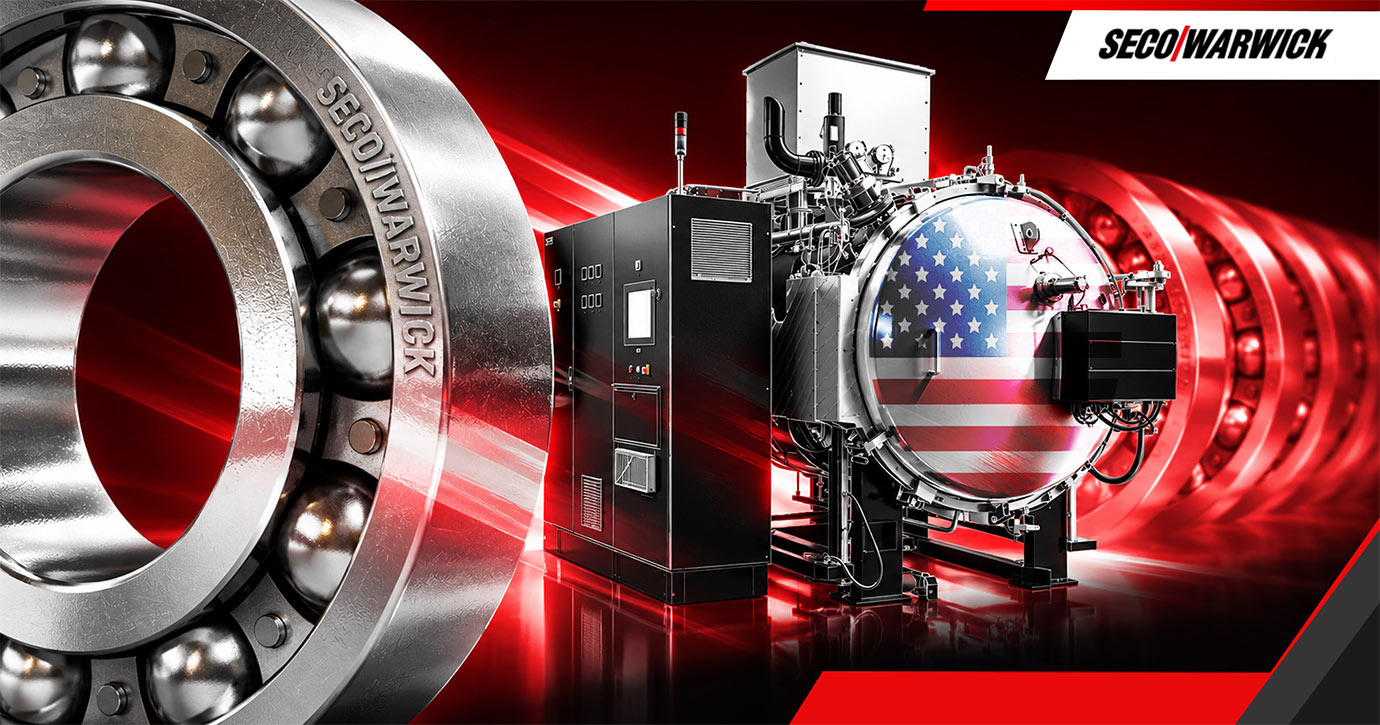




SECO/WARWICK is developing and building a prototype Free High Pressure Gas Quenching system designed for free quenching of parts.

With funding from European Funds, SECO/WARWICK is carrying out an innovative project to develop a Free High Pressure Gas Quenching (FHPGQ) system for free quenching of steel parts in high-pressure gas, enabling process control and minimizing quench distortion.
The project focuses on creating an alternative to traditional oil-quench presses that offers better operating and environmental performance.
As part of the project, R&D work includes developing the design of a prototype system for free-quenching steel parts in high-pressure gas, building it, and testing it under near-real conditions using representative parts with simplified geometry, as well as pilot tests using selected production parts. These activities are aimed at eliminating key process, operating, and environmental limitations typical of currently used oil‑based solutions.
The project scope includes designing the prototype system using advanced numerical simulations (CAE), including gas flow, heat transfer, and structural strength analyses. Based on these results, the team is building an FHPGQ prototype along with a dedicated, prototype research line that includes the necessary process tooling—such as a furnace for preheating the load before quenching and a transfer robot—as well as measurement equipment, in particular thermal imaging cameras and a 3D scanner for measuring part distortion.
A key part of the project is technology research and testing on representative and production parts, aimed at determining how quenching parameters affect the magnitude, distribution, and repeatability of part distortion and at confirming the system’s target operating and environmental performance. In parallel, a digital twin of the FHPGQ system is being developed and validated, enabling the prediction of quench distortion and supporting the design and optimization of heat‑treatment processes.
The solution is intended for organizations that perform heat treatment of steel parts—especially in the aerospace, automotive, and machinery industries. Project results will benefit component manufacturers with both horizontal and vertical integration, for whom reducing and repeatedly achieving low quench distortion is critical, along with improving the process’s environmental and operating performance versus traditional oil quench presses. Indirect beneficiaries will also include process engineering and design teams that develop heat‑treatment processes using digital tools.



Total project cost:
$2,568,084.68
European Funds contribution:
$1,404,430.15
Contract signing date:
November 28, 2025