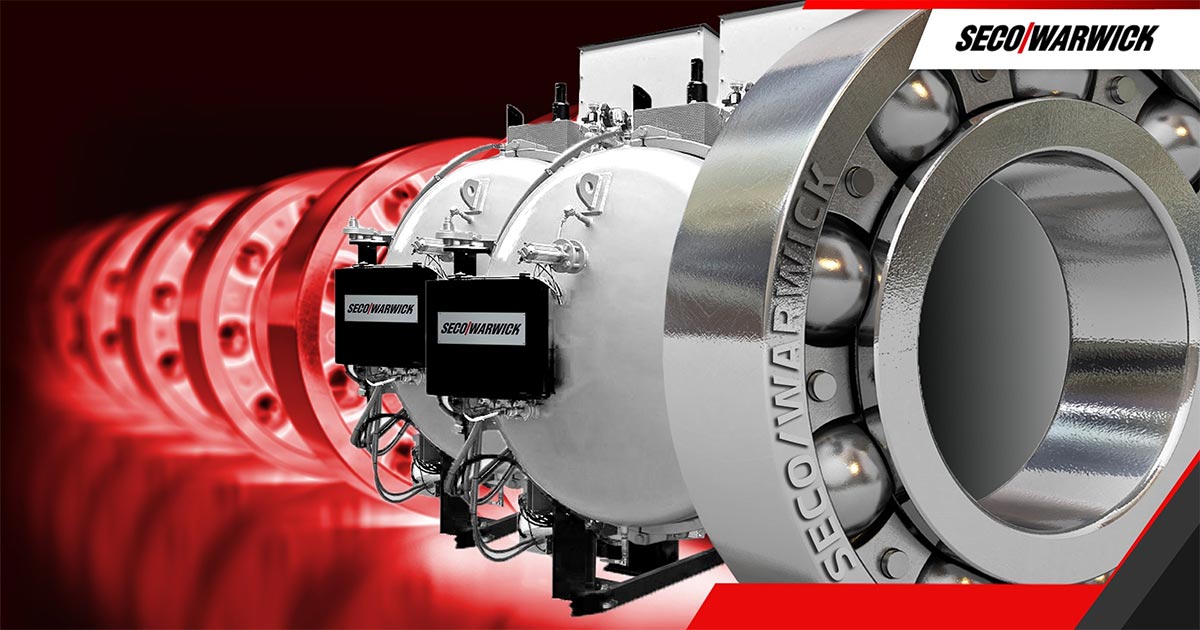




A U.S. based manufacturer of bearings for demanding industrial and aerospace applications has once again invested in SECO/WARWICK vacuum technology. One of its facilities will receive a Vector vacuum furnace with high-pressure gas quenching (HPGQ) and Low Pressure Carburizing (LPC) option. This is another project completed for this Partner, and the first SECO/WARWICK system at this facility.
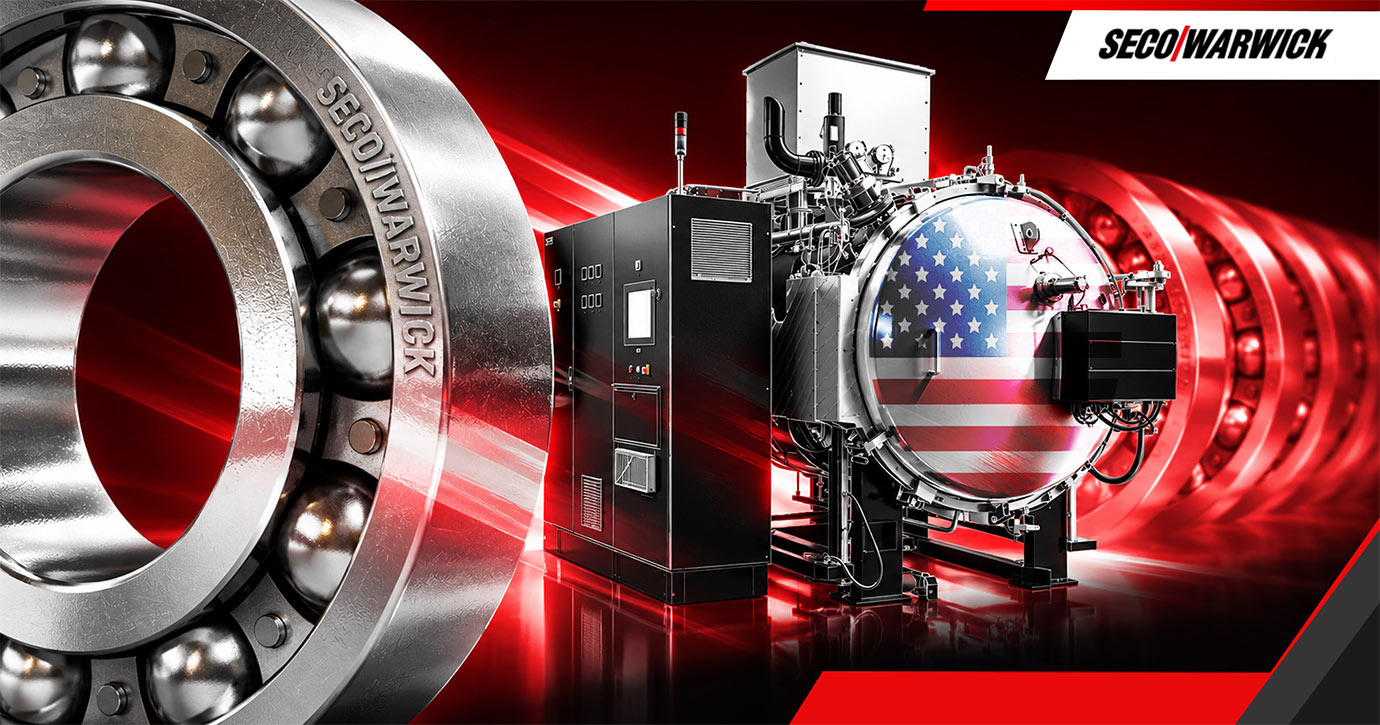
A major aerospace partner expanded its in-house heat treatment capacity by purchasing another SECO/WARWICK Vector vacuum furnace to handle larger bearing components.
- Repeat purchase confirms technology reliability
- New furnace features a large 36x36x48 inch (900 × 900 × 1200 mm) working zone
- Includes Low Pressure Carburizing (LPC) technology
- Provides precise temperature uniformity and cooling control
- Supports growing production needs in aerospace and beyond
A Proven Partner in Aerospace Manufacturing
In industry, the strongest endorsement of a technology is not a claim, but a repeat purchase. SECO/WARWICK’s U.S. Partner has decided to make another investment in vacuum technology, expanding its in-house heat treatment capabilities for bearing components. The new furnace will be used for hardening and carburizing a broad range of components, including larger loads. A working zone measuring 36 × 36 × 48 in (900 × 900 × 1200 mm) enables the system to efficiently process larger parts as well. The investment addresses the customer’s growing production needs and the increasing number of hardening and carburizing processes performed in-house.
“A returning customer is powerful confirmation that the technology has proven itself where it truly matters—in day-to-day production. For this Partner, the experience of other facilities within the same Group and references from the U.S. market also played an important role. This latest investment demonstrates that Vector has become a solution that can scale with production needs. The aerospace industry has embraced this system, and SECO/WARWICK Vector furnaces operate at the world’s leading aerospace manufacturers,” said Don Marteeny, Managing Director of SECO/WARWICK USA.
Large Loads, a Clean Process and Controlled Cooling
The furnace on order belongs to SECO/WARWICK’s proven family of single chamber vacuum furnaces. The standard design has been configured to meet the bearing manufacturer’s specific needs.
The system features a cylindrical heating chamber that provides temperature uniformity of ±9°F (±5°C). Convection heating improves heat transfer at lower operating temperatures, while the directional cooling system enables proper process control for parts with more demanding geometries. Another important feature is isothermal quenching, which enables more precise control of load cooling and blower power at individual stages of the process.
The furnace is also equipped with Low Pressure Carburizing (LPC) technology, allowing the steel surface-hardening process to be performed as part of an integrated heat treatment cycle. This is particularly important for bearing manufacturers. Carburized case parameters, process repeatability and the cooling method directly affect the performance of components that will later operate under heavy loads.
“When manufacturing components are subject to stringent quality requirements, simply reaching the specified temperature is not enough. What matters is control of the entire process: heating, atmosphere, carburizing and cooling. The combination of high vacuum, LPC, and 15 bar gas quenching gives the user a very broad range of process capabilities in a single system. At the same time, we are working with a design that we have refined over many years and validated in thousands of actual industrial processes,” emphasized Maciej Korecki, Vice President of the Vacuum Segment at the SECO/WARWICK Group.
Technology That Grows with Production
The new system is intended primarily to expand the capabilities of the customer’s existing heat treatment department. The large working zone will allow larger batches of components to be processed, while high vacuum, an efficient graphite hot zone, and rapid gas cooling are expected to improve process economics, cleanliness and repeatability.
Heat treatment is one of the processes that directly affect component hardness, fatigue resistance, dimensional stability and service life. For parts intended for aerospace or other demanding industrial applications, the margin for error is narrow.
It is worth noting that vacuum gas quenching and low pressure carburizing is no longer limited to aerospace or defense applications; they are also being used increasingly in the production of bearings for the energy, transportation, heavy industry and OEM sectors.