

During the SECO/WARWICK Group project for the aluminum homogenization line (5 burner furnaces + cooling + loader + master system + safety), it was the ideal time to fully launch the control logic on a virtual PLC before on-site installation.
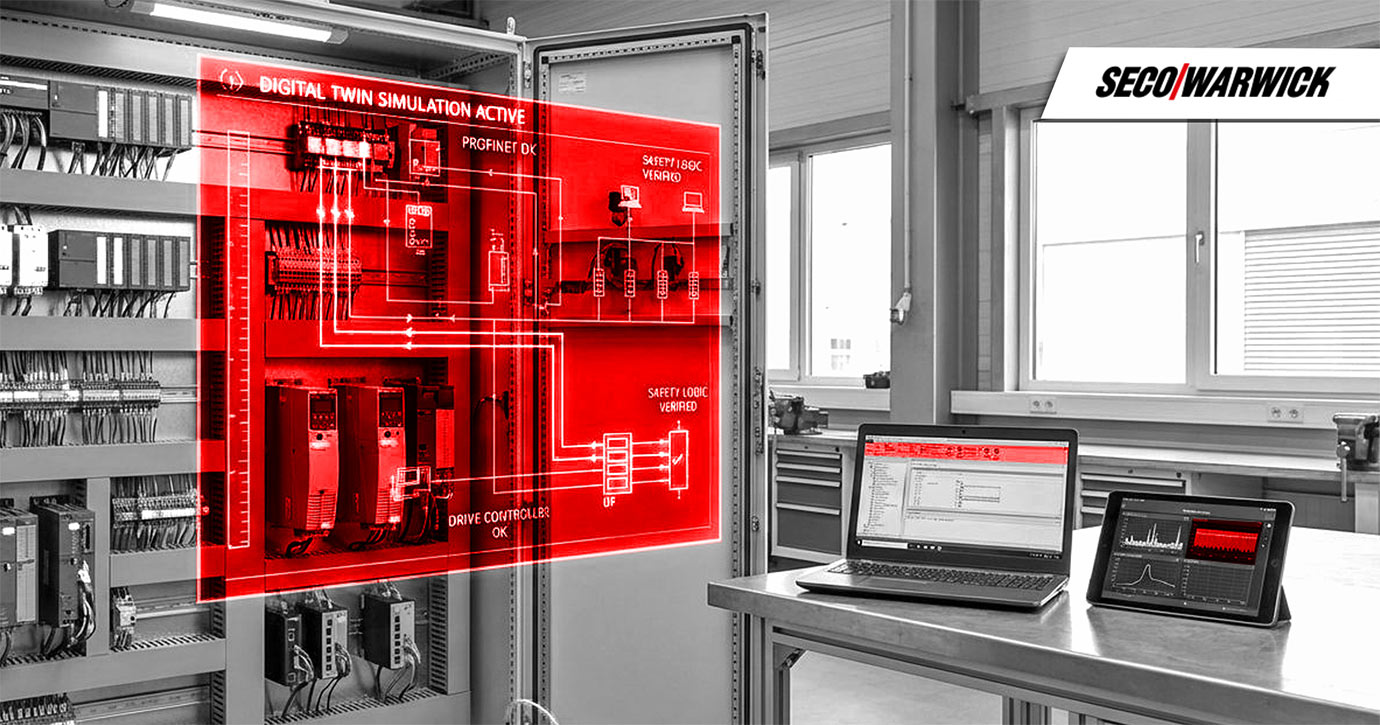
What did the implementation of a digital twin deliver in practice?
Reduction of process risk
The model showed that the current temperature-control method could lead to uneven heating of the charge. The algorithm was changed before the physical equipment was started up. The logic was updated so that the selection of the active thermocouple depended on the direction of the mixer’s operation in the zone. No downtime. No “on-the-fly” corrections.
Effect? More stable process control even before the physical start-up.
Safety – tests you don’t do “live.”
In the virtual environment, we ran a complete heat-up sequence:
/ gas installation leak test
/ verification of air pressure sensors
/ logic for the actual burner configuration
The Digital Twin revealed inconsistencies between the program assumptions and the actual installation configuration.
The correction was applied before the facility was started up.
Such scenarios in a real environment always entail costs and risks.
PROFISAFE and emergency responses
The simulation revealed that opening the gate did not stop the loader.
After testing, we implemented PROFISAFE communication and verified the global E-STOP logic for the entire line.
These are exactly the scenarios you don’t want to test for the first time “live.”
Faster and More Predictable Production Start.
Would these problems have appeared during classical and physical testing?
Yes – sooner or later.
The difference is that thanks to the Digital Twin:
/ you can correct the logic virtually, in the office
/ you don’t delay the team’s work on site
/ you reduce tensions between the automation, mechanical and commissioning teams
/ you give service engineers much greater comfort at start-up (calmer and more predictable)
The Digital Twin does not replace physical tests.
It gets ahead of them.
And it turns commissioning from “crisis management” into a controlled project stage.
FAQ
What is a Digital Twin in industrial automation?
It’s a virtual model of a line/equipment and PLC logic that allows you to test control, safety, and sequences before commissioning at the plant.
What are the key benefits?
Reduction of process risk, safety validation (PROFIsafe/E-STOP), shorter and more predictable commissioning, lower costs and downtime.
/ Reduced process risk
/ Earlier detection of control errors
/ Elimination of burner configuration inconsistencies
/ Improved line safety
/ Shorter and smoother commissioning stage
Does it replace on-site testing?
No. It precedes them and eliminates problems before they become costly.
Does the Digital Twin affect the predictability of production start-up?
Yes. In the analyzed project, the start-up phase ceased to be high-risk.
Thanks to the Digital Twin:
/ The logic was verified earlier
/ Emergency scenarios were tested
/ Corrections were made before physical assembly
/ Production start-up was calmer and more controlled
What is virtual commissioning?
Virtual Commissioning is the process of testing and launching a PLC program in a simulation environment before the physical machine is installed.
In practice, it means:
/ Testing start-up sequences
/ Verifying control algorithms
/ Checking communication between devices
/ Safety system tests
/ Simulation of emergency states