



Vacuum Carburizing
FineCarb Vacuum Carburizing
In Short: Vacuum carburizing (low-pressure carburizing, LPC) is a case hardening process for steel parts. Carbon is diffused into the part surface in a vacuum furnace. The parts are then hardened by gas quenching. SECO/WARWICK FineCarb technology delivers a repeatable case depth from 0.1 mm to 5 mm.
Key advantages of FineCarb:
- Repeatable results: Uniform carburized case from 0.1 mm to 5 mm, cycle after cycle.
- Unique gas mixture: A dedicated carburizing gas mixture developed by SECO/WARWICK.
- Clean process: No soot or tar by-products. A green manufacturing process.
- Automatic atmosphere control: Carburizing atmosphere flow adjusts automatically to the charge size.
- Shorter cycles: Carburizing temperature up to 1150 °C reduces cycle time.
- Grain growth control: PreNitLPC technology limits grain growth in high-temperature carburizing.
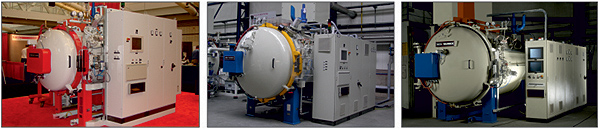
Single-chamber furnaces
/ 10,12,16,25bar
/ 400x400x600mm 200/300kg
/ 600x600x900mm 600/1000kg
/ 900x800x1200mm 1200/1500kg
Double chamber furnaces
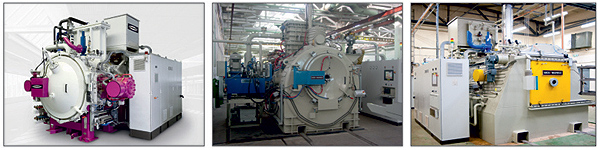
Rotary and Linear Modular Systems
/ 600x660xl000mm 600/1000kg
/ 900x800x1200mm 1200kg
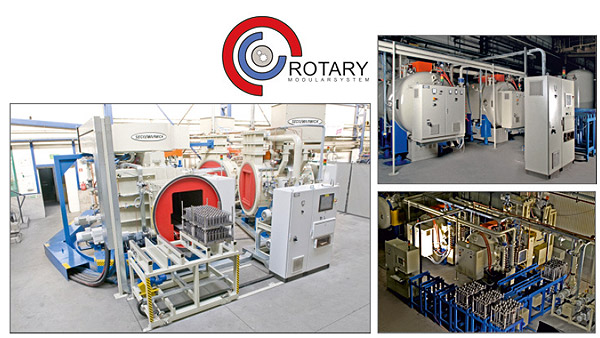
Rotary Modular Systems
/ Compact structure
/ Up to 10 processes chambers
/ Easy operation and maintenance, high efficiency
/ Perfect for medium-series production
Flexibility and variety of processes
Design Features of SECO/WARWICK furnaces
/ Compact design, easy operation, low consumption of energy and process gas, high efficiency with low operating and maintenance
/ Heating chambers equipped with Curved, wide heating elements, providing efficient heating and high uniformity
/ Suitable for wide range of carburizing technologies and gas quenching
/ Seco Vac control system facilitating operation, programming of new tasks, device operation optimization, including queuing for modular lines, reporting functions, etc.
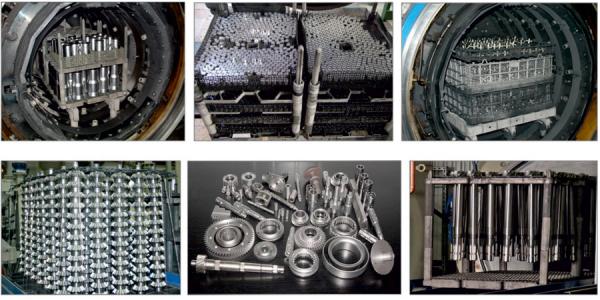
Gas Quenching
After carburizing, parts are hardened with high-pressure gas instead of oil. SECO/WARWICK furnaces control this step precisely.
- Software-controlled cooling speed: Gas pressure and blower speed are adjusted in each cycle stage.
- Choice of quenching gas: N2, He or H2 at pressures up to 25 bar.
- Oil-like performance: Quenching in helium reaches a capacity close to oil quenching.
- Separate cooling chamber: Available in double-chamber furnaces and modular systems. It extends the application to 16MnCr5/8620 steels (range MQ1/2 DIN 3990).
- Low, repeatable distortion: Cooling is uniform and the distortion field is repeatable.
- Circular cooling system: Reversible top/bottom gas flow enables fast cooling.
- ConFlap convective heating: Used in single-chamber VPT furnaces. It shortens hardening cycles before the Ms transformation and significantly reduces part distortion.
SimVac Process Simulator
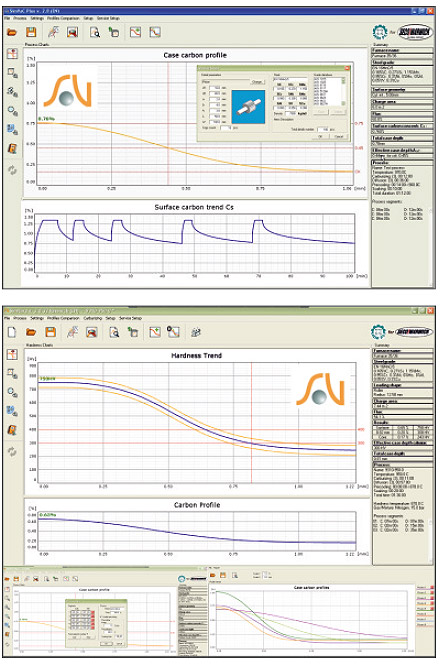
SimCarb module enables designing of vacuum carburizing processes prior to
running trials saving actual process time and reducing number of scrapped
/ Optimal segment planning of carburizing process split to boost and diffusion (holding) phases
/ Calculations based on steel grade, sizeand shape of parts, as well as Cooling profilefor hardening
/ Manual or automatic simulation mode
/ Carburizing cost reduction
/ lntuitive users interface
/ Fully compatible with furnace control system Secovac
SimHard module – gas hardening simulator is an additional
technology support that enables:
/ Simulation of hardness distribution upon the basis of achieved carbon profile
/ Including the cooling characteristics of SECO/WARWICK furnaces into the calculations
/ Designing of carburizing process for required mechanical properties TWV
/ Detailed calculation of carbon profile considering charge configuration and geometry
/ Manual or automatic simulation mode
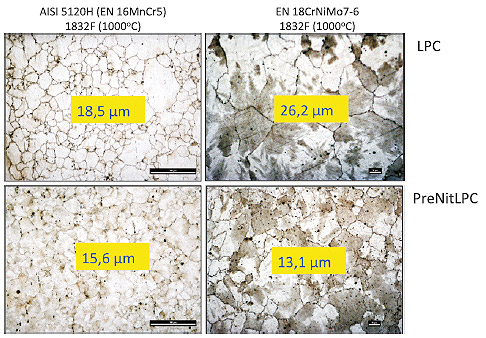
PreNitLPC technology:
/ Limits grain growth in high-temperature processes (above 1000°C)
/ Accelerates case creation
/ Reduces retention of austenite and carbides formation
/ Shortened process duration
Frequently Asked Questions
What is vacuum carburizing?
Vacuum carburizing (low-pressure carburizing, LPC) is a case hardening process. Carbon is diffused into the steel surface in a vacuum furnace, and the parts are then hardened by gas quenching. SECO/WARWICK FineCarb delivers repeatable case depths from 0.1 mm to 5 mm.
What is PreNitLPC technology?
PreNitLPC is a SECO/WARWICK technology for high-temperature carburizing above 1000 °C. It limits grain growth, accelerates case creation and reduces retained austenite and carbide formation. As a result, process duration is shorter.
What is the Ms transformation and why does it matter?
Ms is the temperature at which austenite starts to transform into martensite during quenching. The ConFlap system in single-chamber VPT furnaces shortens hardening cycles before this point, which significantly reduces part distortion.
Which gases are used for quenching after vacuum carburizing?
SECO/WARWICK furnaces can quench with nitrogen (N2), helium (He) or hydrogen (H2) at pressures up to 25 bar. Quenching in helium reaches a capacity close to oil quenching.
How does the SimVac simulator support vacuum carburizing?
The SimCarb module designs carburizing processes before trials, which saves process time and reduces scrap. The SimHard module simulates hardness distribution based on the achieved carbon profile.